
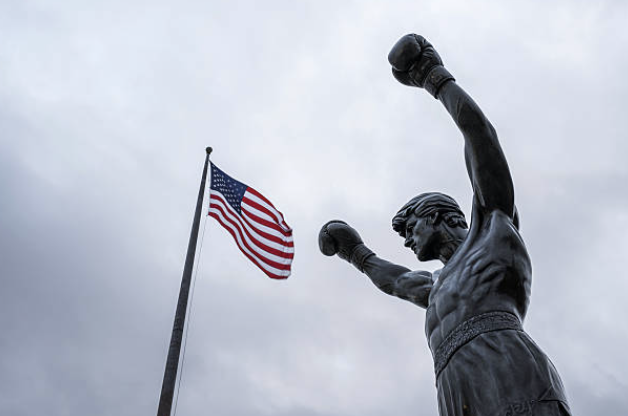
The bronze Rocky Balboa statue in Philadelphia.
(Photo: Getty Images)
Leading Yourself 101
Veterans Day is November 11. Before we can lead anyone else well, we have to lead ourselves.
My co-captain on the Army boxing team in 2003 is still an amazing friend of mine. After graduation, Boyd Melson boxed in the Army's World Class Athlete Program, won the World Military Boxing Championship, captained the 2005 Team USA men's world boxing team, and was an alternate for the 2008 U.S. Olympic team. He then turned pro, won the WBC USNBC super welterweight title, and donated his purses to spinal cord injury research. Along the way he deployed for Operation Inherent Resolve, earned an MBA and a Master of Liberal Arts in Psychology from Harvard, and is now a doctoral candidate at USC. He's a lieutenant colonel in the Army Reserve. He’s also expecting a little girl in the new year.
Boyd recently wrote a piece for RealClearDefense arguing that the Army should deliberately train leaders to make decisions under pressure. It's worth your time. Read it here.
What Boyd learned in the third round
In the third round of an eight-round pro fight, Boyd lost the use of his right arm to a nerve injury. His first instinct was to picture himself getting beaten while he couldn't defend himself, and to quit. Instead he took stock of what he still had: his legs, his conditioning, a clear head, and one working arm. He fought the last five and a half rounds with his non-dominant hand, picked his moments, and won.
That's leading yourself under pressure. What stuck with me just as much is what he does after moments like that. He treats self-control as a well with a limited supply. Fear, anxiety, and dread draw from it first, so by the time a big decision shows up, the well may already be low. His fix is to go back over the decision step by step. What did you notice? What were you feeling? What options did you have? Why did you choose what you chose?
We learned this together
The Army is very good at putting people under pressure. It's also good at learning from it as a unit. That's what the After Action Review is for: what was supposed to happen, what actually happened, why was there a difference, and what do we sustain or improve.
What made the AAR work was the people in the circle. Someone told you what you missed. Someone owned their part so you could own yours. Rank mattered less than the truth for those few minutes. Most of us got better because the people around us held us to that standard, and some of the people I sat in those circles with are still the first ones I'd call today. Boyd is one of them.
Then we got out, and nobody gathers us up anymore. Nobody runs an AAR on the job you took, the conversation you avoided, the business you started, or the year that didn't go the way you planned. Individual decisions are where most of us stop debriefing. That's the gap, and closing it is the most basic part of leading yourself.
Why I'm writing this now
This has been a difficult year for me. I'm not ready to get into the details yet, but I'm running this process on myself right now, so treat what follows as a method I'm testing and not a finished one.
The risk with looking back at a hard year is that reflection turns into rumination. You replay the same moments, feel worse each time, and learn nothing new. Research from psychologist Ethan Kross at the University of Michigan suggests the difference comes down to perspective. When people analyze a painful experience while fully immersed in it, they tend to ruminate. When they step back and look at it like an outside observer, they get more insight and less distress. The steps below are built around that idea.
Leading Yourself 101: The personal AAR
1. Show up for it.
Do this rested, calm, and somewhere quiet. In Boyd's terms, don't start when your well is empty. Go in ready to give yourself some grace. Things may not have worked out the way you wanted, and you don't need to punish yourself for it now. The point is to learn, not to assign blame. That's the standard we held a good AAR to.
2. Gather the facts before you form opinions.
Pull up your emails, your calendar, your texts, your notes. Memory is unreliable, especially about stressful periods, so build the record first. This is a good job for AI. Export or paste in what you have and ask it to put together a timeline of the year's major events.
3. Walk the timeline and pick the major decisions.
Look at what happened in order and identify the big calls you made or had to make. Limit yourself to the handful that mattered most. Trying to review everything is how this turns into a project you never finish..
4. Own the outcome, but judge the decision.
For each decision, ask:
What were the circumstances?
How did I feel at the time?
What were my options?
Why did I choose what I chose?
What were the results?
When did I know whether it was a good or bad decision?
Did I do what I said I would?
Owning the outcome means no excuses and no finger-pointing. It doesn't mean judging every decision by how it turned out. Former poker champion Annie Duke calls that mistake "resulting." A sound decision can still go badly because of luck or things you couldn't see, and a bad one can work out anyway. Judge the decision on what you knew and how you reasoned at the time. It also helps to talk about yourself in the third person, as in "Why did Freddie take that offer?" It feels awkward, but that distance keeps you analyzing instead of spiraling.
5. Get better every day.
For each decision, write down one or two lessons at most: what to sustain and what to improve. Then turn those lessons into a plan for next year. Doing all of this in one sitting would be ideal, but most of us don't have the time. I'm using mornings, when my head is clearest, and taking one area per session, such as work, family, health, or money. Set a time limit. If you catch yourself replaying the same moment without learning anything new, stop for the day.
6. Bring someone back into the circle.
Leading yourself doesn't mean doing it alone. Team over ego. Once you've done your own review, call someone you served with and walk them through your biggest decision of the year. Ask what you're missing. They'll see things you can't, the same way they did back then. I’m doing this with Jason, as he’s always helped keep me in line.
Close
Leadership changes everything, and it starts with how you lead yourself. You can't lead others well, follow well, or know when to get out of the way until you can look honestly at your own decisions.
This month we have Veterans Day and Thanksgiving back to back. Run your own AAR. Continue to learn and grow.
Press on,
Freddie
If this resonated, join Azimuth Check: Adjusting your bearings after honorable service — a monthly reset for leaders adjusting their bearings after honorable service.
[Get in Touch]
